


Traveling across Mexico means realizing that the country you imagined before your trip was only a small part of everything you were about to discover.
Along the way, some of the most iconic images associated with Mexico pyramids, Maya culture, mariachi music, and colonial cities — coexist with canals explored aboard trajineras, communities that keep their traditions alive, cities surrounded by mountains, agave fields, jungles, waterfalls, and landscapes that transform as the journey unfolds.
This variety makes traveling to Mexico with Europamundo feel like several trips in one. Depending on the itinerary you choose, the journey can take you through different regions of the country while combining archaeological heritage, historic cities, nature, and included experiences that help reveal everything behind Mexico’s best-known landmarks.
Because Mexico is not discovered all at once: it reveals itself one stage at a time.
Mexico: an identity that changes from region to region
Its diversity is not only found in the distances between one region and another. It is also reflected in its cultures, architecture, traditions, and in the way each destination tells a different part of Mexico’s story.
Europamundo’s different itineraries make it possible to explore these facets from a wide range of perspectives. Some routes focus mainly on central and western Mexico; others continue toward Oaxaca and Chiapas; certain itineraries reach the Pacific coast, while others continue through the Yucatán Peninsula.
So, even before choosing your itinerary, there is one question worth asking: which Mexico do you want to discover?


Mexico City: canals, history, and a great metropolis
On different itineraries, Mexico City becomes one of the main starting points for understanding the country.
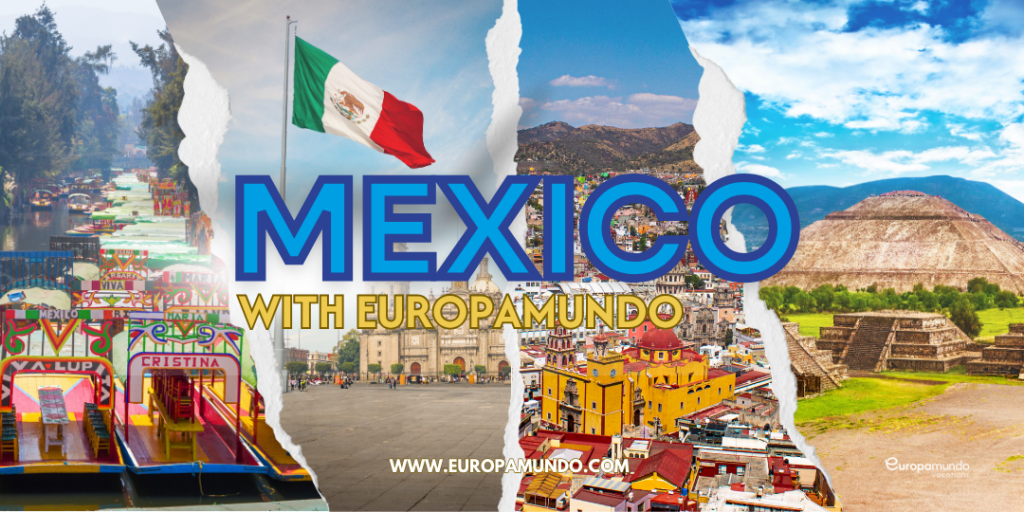
Some circuits include an experience closely connected to the capital’s identity: a trajinera boat ride through Xochimilco, cruising along its canals and discovering a landscape very different from the heart of the city.
Then, depending on the program, a panoramic tour may introduce travelers to places such as the Plaza de las Tres Culturas, the Zócalo, the Metropolitan Cathedral, the area around the Templo Mayor, Chapultepec Park, and Paseo de la Reforma.
Certain itineraries also include a visit to the Basilica of Our Lady of Guadalupe, one of the country’s most important religious landmarks.
In a single stage of the journey, Mexico City takes you from traces of the pre-Hispanic past to the colonial era and the energy of one of the largest metropolises in the Americas.
Teotihuacán: face to face with one of ancient Mexico’s great symbols
Not far from the capital, some Europamundo itineraries include admission to Teotihuacán, one of Mexico’s most recognizable archaeological sites.
The visit provides an opportunity to explore sites such as the Pyramids of the Sun and the Moon, the Avenue of the Dead, the Citadel, and the Temple of Quetzalpapálotl.
Seeing these structures helps travelers understand the scale of the civilizations that inhabited Mexican territory long before the arrival of the Spanish.
On certain circuits, the day also includes a stop at an artisan center before continuing the journey.
Michoacán: Pátzcuaro, Janitzio y las raíces purépechas
The landscape changes once again upon entering Michoacán.
On some routes, the journey reaches Lake Pátzcuaro, where a boat ride to Janitzio is included. The island is home to a Purépecha community.
Here, traditions, handicrafts, and a way of life closely connected to the lake come into view. The journey then continues to Pátzcuaro, where pre-Hispanic roots coexist with colonial architecture and artisan markets.
Depending on the itinerary, travelers may also visit Morelia, whose historic center stands out for its pink-stone buildings, plazas, and monumental heritage.
These stages offer the chance to discover a part of Mexico closely connected to local traditions and to a culture that remains deeply present in everyday life.


Guadalajara, Tlaquepaque, and Tequila: traditions that have traveled around the world
As the journey continues toward Jalisco, some of Mexico’s most internationally recognized symbols begin to appear.
Certain circuits include a visit to Guadalajara, exploring its historic center and several of the city’s most representative landmarks. Included visits may feature the Hospicio Cabañas, a UNESCO World Heritage Site known for the murals of José Clemente Orozco.
Depending on the route, the journey may also pass through Tlaquepaque, where handicrafts and mariachi music are part of the atmosphere.
Some programs also continue to Tequila, crossing the region’s distinctive agave fields. There, Europamundo includes admission to Mundo Cuervo on certain itineraries, where travelers can learn about the tequila-making process and enjoy a tasting.
Visiting these places offers the opportunity to discover, at their source, Mexican traditions that have become famous far beyond the country’s borders.
Guanajuato and San Miguel de Allende: the charm of colonial Mexico
The cities of central Mexico add another personality to the journey.
Guanajuato, with its narrow streets, hills, tunnels, and historic architecture, is featured on several Europamundo circuits.
Some also include the funicular, which offers a panoramic view of the city from the Pípila area before descending toward the center.
Depending on the route, the journey may continue through San Miguel de Allende, Dolores Hidalgo, Querétaro, or Puebla.
Each place reveals a different part of Mexican history and shows how, when traveling by road, it is not only the scenery that changes: the architecture, traditions, and character of each region change as well.
Oaxaca and Monte Albán: following the traces of the Zapotec civilization
Oaxaca opens one of the most fascinating cultural and archaeological chapters of the journey.
Different Europamundo programs include a visit to the archaeological site of Monte Albán, located above the Valley of Oaxaca.
Admission and the visit provide the opportunity to explore this ancient center of the Zapotec civilization, with platforms, pyramids, and other spaces that help travelers imagine the importance the city once held.
Then, depending on the itinerary, the journey may be complemented by a visit to Oaxaca, whose identity can be seen in its architecture, plazas, handicrafts, and traditions.
It is another example of how Indigenous and colonial heritage constantly coexist throughout a journey across Mexico.
Chiapas: nature and cultures that preserve their traditions
Farther south, Chiapas transforms the scenery once again.
On certain circuits, one of the highlights is Sumidero Canyon, where Europamundo includes a boat ride between its towering natural walls.
The route may then continue through places such as Chiapa de Corzo, Zinacantán, and San Juan Chamula before reaching San Cristóbal de las Casas.
These stages bring travelers closer to mountain landscapes and communities that preserve languages, customs, and traditions of Maya origin.
At other points along the journey, water once again takes center stage. At Agua Azul, certain itineraries include admission to the park, where waterfalls and lush vegetation create one of Chiapas’ most recognizable natural landscapes.
Some programs also include lunch during this stage of the journey.

Palenque: an ancient Maya city surrounded by vegetation
After crossing the landscapes of Chiapas, some itineraries reach one of Mexico’s great archaeological sites: Palenque.
On itineraries that include it, Europamundo provides admission and a visit with a local guide to the archaeological complex.
Temples, pyramids, and other remains of the ancient Maya city appear surrounded by lush vegetation, creating a setting completely different from Teotihuacán or Monte Albán.
That is precisely part of the richness of Mexico’s archaeological heritage: each site tells a different story and has its own unique relationship with the surrounding landscape.
Yucatán: Chichén Itzá, nature, and cenotes
The Yucatán Peninsula introduces a new collection of landscapes and experiences.
Some itineraries pass through Mérida and Izamal before reaching Chichén Itzá, one of the best-known archaeological sites of the Maya civilization.
On certain Europamundo circuits, admission and a visit to the complex are included, with the opportunity to see landmarks such as the famous Pyramid of Kukulcán and other monumental spaces.
And this stage has another interesting detail: after the visit, some programs include a meal featuring Maya cuisine.
The journey may continue toward Río Lagartos, within a biosphere reserve where certain itineraries include a boat ride through mangrove landscapes home to numerous bird species.
Depending on the route, another experience closely associated with Yucatán follows: Choj Ha Cenote, managed by a local Maya community. Access is via a short trail, and during the visit travelers can explore the cave and swim in its underground lake.
Heritage and nature come together once again in the same part of the journey.
Mexico’s Pacific coast: when the journey reaches the sea
Not every route continues toward Yucatán.
Other circuits offer the opportunity to discover part of Mexico’s Pacific coast, adding entirely new landscapes to the experience.
On routes that pass through Acapulco, for example, admission and a visit to La Fortaleza are included, a 17th-century structure built to protect the city from pirate attacks.
Other itineraries continue to Zihuatanejo, where a short boat ride to Playa de las Gatas, accessible by sea, is included.
After historic cities, mountains, and archaeological sites, reaching the coast completely changes the perspective of the journey.
And this ability to transform from one stage to the next is one of the characteristics that best defines Mexico.


Flavors of Mexico: a cuisine that also tells stories
Traveling through Mexico without exploring its cuisine would mean missing an essential part of the country’s identity.
And talking about Mexican cuisine means talking about tremendous regional variety.
Tacos, tamales, and corn tortillas coexist with recipes that change from state to state. Puebla is associated with dishes such as mole poblano; Oaxaca is known for its different types of mole and tlayudas; while in Yucatán, flavors such as cochinita pibil and other recipes linked to regional traditions take center stage.
Along the coast, fish and seafood introduce new flavors to the journey.
In addition, on certain Europamundo circuits, gastronomy becomes part of the included experiences, as is the case with the Maya-style meal following the visit to Chichén Itzá.
Tasting local flavors is another way to discover just how much Mexico changes as the journey unfolds.
A comfortable and organized way to explore Mexico
Traveling across a country of this size means connecting very different regions.
With Europamundo, many of the journeys between destinations take place by road aboard a motorcoach, offering the opportunity to watch the landscape change along the way while connecting cities, historic sites, and natural areas.
In addition, depending on the circuit chosen, the journey combines transportation with panoramic tours, admissions, excursions, and other included experiences, accompanied by guides who help travelers better understand each stage of the itinerary.
The wide variety of programs makes it possible to choose trips focused on specific regions or much more extensive circuits that combine different parts of the country.
That is why, before deciding on your trip, it is worth exploring the available itineraries and reviewing the visits and experiences included in each program.
Get inspired by Mexico on EuropamundoPhotos
Even before arriving at a destination, photographs can be one of the best ways to start imagining it.
On EuropamundoPhotos, you can discover Mexico through images shared by travelers who have already explored the country with Europamundo.
Historic cities, archaeological sites, landscapes, monuments, and small moments along the way offer the chance to see the destination through the eyes of those who have already experienced the journey.
And once you return from your own trip, you can also share your photographs and turn your memories into inspiration for other travelers.


Mexico: a journey that reveals itself one stage at a time
A trajinera gliding through Xochimilco. The monumental scale of Teotihuacán. A boat heading toward Janitzio. The streets of Guanajuato. Jalisco’s agave fields. The Zapotec traces of Monte Albán. The mountains of Chiapas. An ancient Maya city surrounded by vegetation. The waters of a cenote in Yucatán.
They are very different images, yet they all belong to the same country.
And perhaps that is one of the greatest reasons to travel to Mexico: discovering that behind every region lies a new way of understanding the country.
Depending on the itinerary chosen, traveling to Mexico with Europamundo makes it possible to combine some of these experiences within an organized journey, discovering both its great icons and destinations that reveal other sides of its culture, history, and nature.
Explore the different itineraries available at europamundo.com and discover which route best matches the Mexico you want to experience.
And for more inspiration, destinations, and travel experiences, follow us at @europamundovacations.
Now we want to hear from you: if you could choose just one experience to begin your journey through Mexico, what would it be? Tell us in the comments.